Karadeniz Technical University identifies students who fall within the bottom 20% of the household income distribution in Türkiye as one of its priority groups for socioeconomic support. The University implements various institutional support mechanisms to prevent these students from discontinuing their studies due to financial difficulties, to support their academic progression, and to enable them to complete their education successfully. Within the University’s publicly available “Bottom Financial Quintile Admission Target” framework, students from the lowest 20% of the national household income distribution are explicitly identified as a target group. The same institutional framework states that the application, admission, educational progression, and graduation status of students in this income group are regularly monitored and that various scholarship and support programmes are implemented to support their education.
This approach is further supported by the University’s publicly available “Bottom Financial Quintile Student Support” system. Within the framework of SDG 1 – No Poverty, the University has established a comprehensive support mechanism aimed at meeting students’ basic, social, and academic needs. This system is implemented through the Department of Health, Culture and Sports, the Karadeniz University Development Foundation (KÜVAK), the Career Development Application and Research Centre, and external funding sources. In addition to scholarships and financial assistance, students in need are provided with opportunities related to career development, internships, and employment.
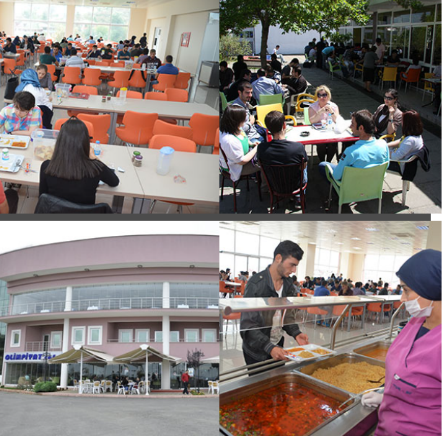
One of the most important components of this support system is the needs-based free Meal Scholarship. Under the Scholarship and Assistance Services administered by the KTÜ Department of Health, Culture and Sports, it is explicitly stated that the Meal Scholarship is awarded to students who are identified as being in financial need. The scholarship is funded directly from the budget of the Department of Health, Culture and Sports and provides eligible students with one free lunch per day in University dining facilities for one academic year. Within the same institutional system, students in need may also receive a Financial Assistance Scholarship, and students seeking accommodation scholarships may contact the Scholarship and Assistance Office for support
Evidence: https://www.ktu.edu.tr/sks/bursveyardimhizmetleri
This mechanism was actively implemented in 2025. The University accepted applications for the 2025–2026 Academic Year Meal Scholarship between 9 and 15 October 2025 and publicly announced that the results would be published on 17 October 2025, with the scholarship being valid from 27 October 2025 to 30 June 2026. This demonstrates that the needs-based support programme was not merely a policy commitment but was actively implemented in 2025.
Evidence: https://www.ktu.edu.tr/sks/duyuru/yemek-bursu-basvuru-duyurusu
The Meal Scholarship also has a structure that supports students’ academic continuity and retention. According to the results published on 17 October 2025, students who met the specified needs-based assessment score were eligible to receive the scholarship. To finalise the scholarship, undergraduate students were required to have a cumulative GPA of 2.00 or above, while postgraduate students were required to have a cumulative GPA of 2.50 or above. Preparatory-class and first-year students were exempt from this academic requirement. This establishes an institutional link between financial support and students’ academic progression
Evidence: https://www.ktu.edu.tr/sks/duyuru/yerli-ogrenci-yemek-bursu-basvuru-sonuclari
The 2025 Activity Report of the KTÜ Department of Health, Culture and Sports provides additional quantitative evidence regarding the scale of this support. The report explicitly states that “in 2025, meal scholarships were provided to 31,249 students in need studying at our University.” The same report identifies food and accommodation services as components of KTÜ’s institutional student-support system.
Evidence: https://www.ktu.edu.tr/dosyalar/sks_RTqne.pdf
In addition to direct scholarships and free meal support, the University also implements income-support programmes that take students’ economic circumstances into account. The İŞKUR Youth Programme, implemented during the 2025–2026 period, enables students to gain work experience while continuing their studies and to receive financial support. A total of 1,316 student places were allocated across the University. One of the programme’s eligibility requirements explicitly states that the student’s household income must not exceed three times the minimum wage. To verify financial circumstances, salary slips and Social Security Institution (SGK) records for adult household members are required. Thus, household income is used as a concrete and verifiable eligibility criterion within the programme
Evidence: https://www.ktu.edu.tr/sks/iskur-genclik-programi
Preventing students from leaving the University before completing their education due to financial or other difficulties is also linked to KTÜ’s long-term strategic objectives. In the KTÜ 2024–2028 Strategic Plan, Performance Indicator PG1.1.3, “Number of students leaving the University, excluding graduates,” is defined as a separate institutional performance indicator. The baseline value of 2,368 students is targeted to decrease to 1,700 in 2025, 1,300 in 2026, 1,000 in 2027, and 700 by the end of 2028. This demonstrates that student retention and successful completion of studies are institutionally monitored performance areas
Evidence: https://ktu.edu.tr/dosyalar/tr_JQFYj.pdf
In addition, the KTÜ Department of Health, Culture and Sports provides a range of services under a single institutional structure, including food, accommodation, scholarships and financial assistance, part-time employment, support for disadvantaged groups, and psychological counselling. The Department’s official service description explicitly includes needs-based scholarships, free meal scholarships, and opportunities for students to earn income through part-time work at the University outside their class hours. This structure enables economically disadvantaged students to receive support across different areas of need throughout their studies rather than relying solely on one-off financial assistance
Evidence: https://www.ktu.edu.tr/sks/hizmetler-tanitim