Karadeniz Technical University (KTU) has been carrying out comprehensive efforts since 2020 to achieve its goal of becoming a “zero-waste campus.” In this context, the KTU Zero Waste Directive was prepared and officially enacted on May 11, 2020. The main objective of this directive is to ensure that the waste generated through education, research, production, and service activities within the University is collected separately at its source according to recycling categories, safely stored temporarily, transported off-campus under proper conditions, and, whenever possible, reprocessed in recycling facilities. Non-recyclable waste is managed to minimize its environmental and human health impacts. The fundamental principles outlined in the directive include:
• Ensuring the implementation of Environmental Law No. 2872 and related legislation within the University,
• Preventing waste generation unless absolutely necessary,
• Promoting the conversion of waste into reusable materials or ensuring its safe disposal,
• Raising zero-waste awareness among university staff and students,
• Defining zero-waste responsibilities and duties within all university units.
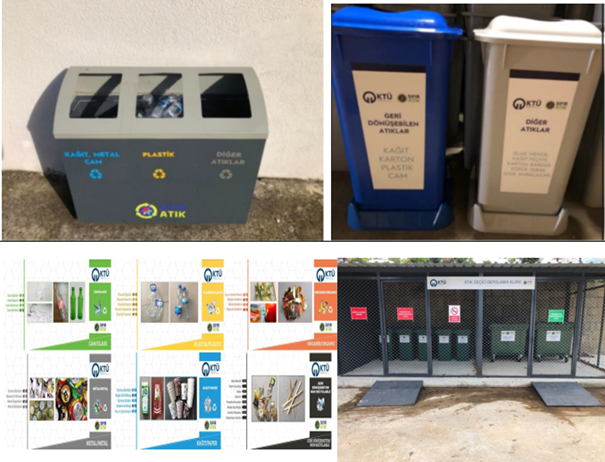
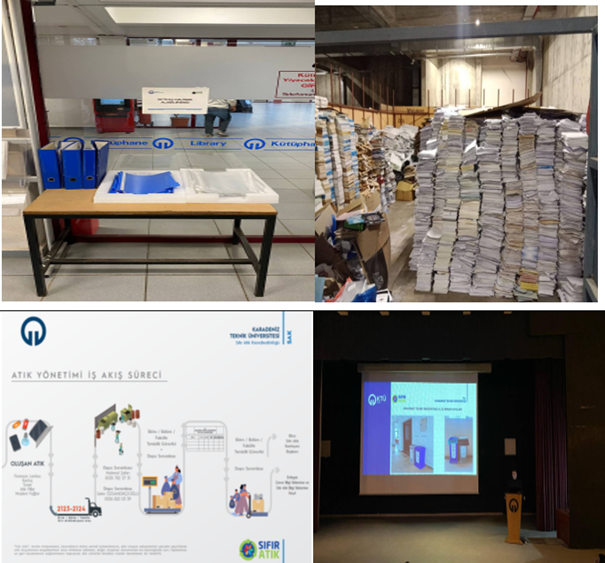
In line with these principles, the KTU Zero Waste Coordination Office was established and has been organized across faculties, institutes, schools, and departments to ensure the effective implementation of waste management processes throughout the campus. To systematize waste management, Waste Management System and Waste Management Workflow Process guidelines were developed in October 2022. To monitor the types and quantities of waste collected from each unit, Waste Delivery Forms were created. These forms are filled out by authorized personnel during waste collection and are used to document and transport all waste types to the temporary storage area. On campus, dual separation bins are placed indoors for recyclable waste (e.g., paper, plastic, cardboard) and other waste (e.g., wet wipes, foam plates), while triple containers (paper, plastic, and other waste) are used in outdoor areas. To promote proper waste segregation among students and staff, the official website of the Zero Waste Coordination Office provides detailed information on waste types and separation methods. Several initiatives have been implemented to prevent waste generation at the source, promote reuse, and increase recycling rates. For example, plastic folders collected from departmental archives are made available in accessible areas for students to reuse.
KTU and its affiliated units were awarded the Zero Waste Certificates by the Ministry of Environment, Urbanization, and Climate Change in 2021 and 2022. Additionally, KTU was selected as one of seven pilot universities in the national project titled “Implementation of Zero Waste and Deposit Management Systems in University Campuses and Development of Standard Practices Across Türkiye”, jointly conducted by the Ministry and the Turkish Environment Agency (TÜÇA).
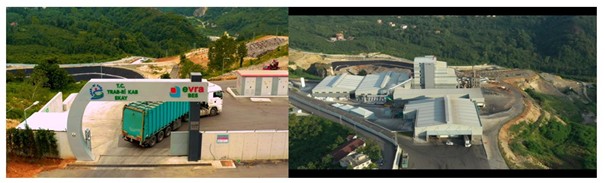
Waste collected across the University is stored in a designated temporary storage area that meets national standards and is subsequently transferred to Trabzon Metropolitan Municipality (Union for the Construction and Operation of Solid Waste Facilities of the Local Governments of Trabzon and Rize Provinces, TRAB-Rİ-KAB) and licensed company Evra Group, which operate integrated solid waste management systems.
The treatment of organic waste is carried out at the KTU Composting Unit, which became operational in 2024, producing compost for use in campus landscaping and green areas. In addition to these operational practices, KTU regularly organizes training sessions and awareness programs on waste management, reuse, recycling, and the zero-waste concept. Periodic activity reports and sustainability reports are also prepared and published. These reports emphasize the integration of waste management with the 3R principles (Reduce, Reuse, Recycle), the Zero Waste Approach, and the Sustainable Development Goals (particularly SDG 12: Responsible Consumption and Production).