Karadeniz Technical University (KTU) provides a range of training and information activities for local and national communities on sustainable land management and agricultural practices. Within this scope, content prepared by our academics is delivered to broad audiences via KTÜ TV. In addition, our university signs cooperation protocols with various institutions and organizations at national and local levels to raise awareness and support practical implementation in sustainable agriculture and land management.
Through these efforts, KTU contributes to regional development while helping communities improve their knowledge and skills in sustainable agriculture.
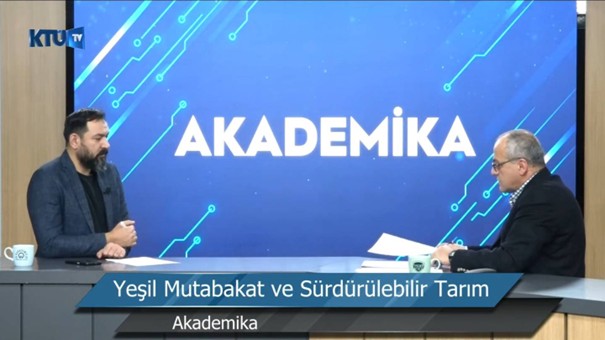
In 2024, Prof. Dr. Erkol Demirci from our department was a guest on the program “Green Deal and Sustainable Agriculture”, produced by the KTU Directorate of Corporate Communications (Radio/TV Unit). The program discussed the principles of the Green Deal and ongoing work in this field. You can access the broadcast via the link below. (Program link)
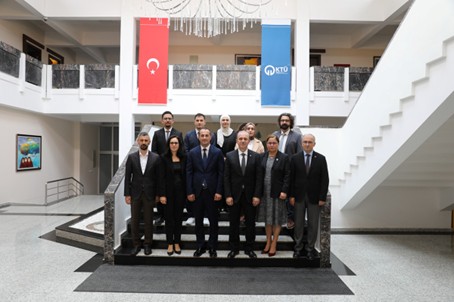
In 2024, a protocol signed between Akçaabat Municipality and Karadeniz Technical University will evaluate the pharmaceutical potential of the superfruit Aronia. The protocol was signed by KTU Rector Prof. Dr. Hamdullah Çuvalcı and Mayor Osman Nuri Ekim on behalf of Akçaabat Municipality, with the participation of the KTU Drug and Pharmaceutical Technology Research and Application Center (İLAFAR). Mayor Ekim emphasized that they lead and support every initiative that will benefit Akçaabat. (News link)
In 2024, in KTU laboratories, fungal spores are being produced to combat the brown marmorated stink bug (Halyomorpha halys), an invasive pest that damages agricultural products—particularly hazelnuts. Prof. Dr. İsmail Demir of the Department of Biology noted that this invasive species, capable of flying approximately 2 km in 24 hours, proliferates rapidly in Türkiye due to the lack of natural enemies. He referenced records from East Asia showing 50–70% parasitism using the samurai wasp, while stressing that biological control with samurai wasps alone is unlikely to suppress the rapidly growing population in Türkiye.
KTU therefore combines biological and chemical methods: laboratory-produced fungal spores have yielded promising results in trials on the pest. As Prof. Demir explains, just as microbes can be lethal to humans, certain microorganisms (bacteria, viruses, and fungi) can reduce pest populations. The key is to select a microbe compatible with the insect’s biology and feeding regime. (News link)
